Most of these started as a problem in the shop that we could not buy our way out of. They are on this page because the plan only works if other people can take them, so all of it is documented and none of it is a secret.
Worker Direction is how this shop is run: democracy, participation, good faith and a
living wage ahead of everything else, drawing on the seven Cooperative Principles. It
is not software and it is not for sale. It is a way of working, written down in enough
detail that somebody else can run it without asking us anything.
In practice it is casual voting, forums where proposals get argued over, paid work
teams, bounties, and the shop paying for study you then teach back. It is also the
on-ramp: a cooperative asks people to be owners, and being an owner is a skill almost
nobody is taught.
Worker cooperatives are over a century old and we invented none of the idea. What is
unusual is a small business converting into one on purpose, in public, and publishing
the method while it is still going wrong in places. Beanchain is building toward a
cooperative rather than claiming to be one already: the word arrives with the first
members.
Each one is out in the world now, used by businesses that have never heard of us and have
no interest in becoming a cooperative. That is the test we care about. A tool that only
works for believers is not a tool, it is a membership badge.
solutionseeking.com
Solution Seeking System
A framework for democratic problem solving, leadership and communication.
solutionseeking.com
If we want to have Democracy in the workplace through systems like Cooperatives, we first need great communication. Communication is hard, and we’re trying to put a common-sense framework around good communication and problem solving.
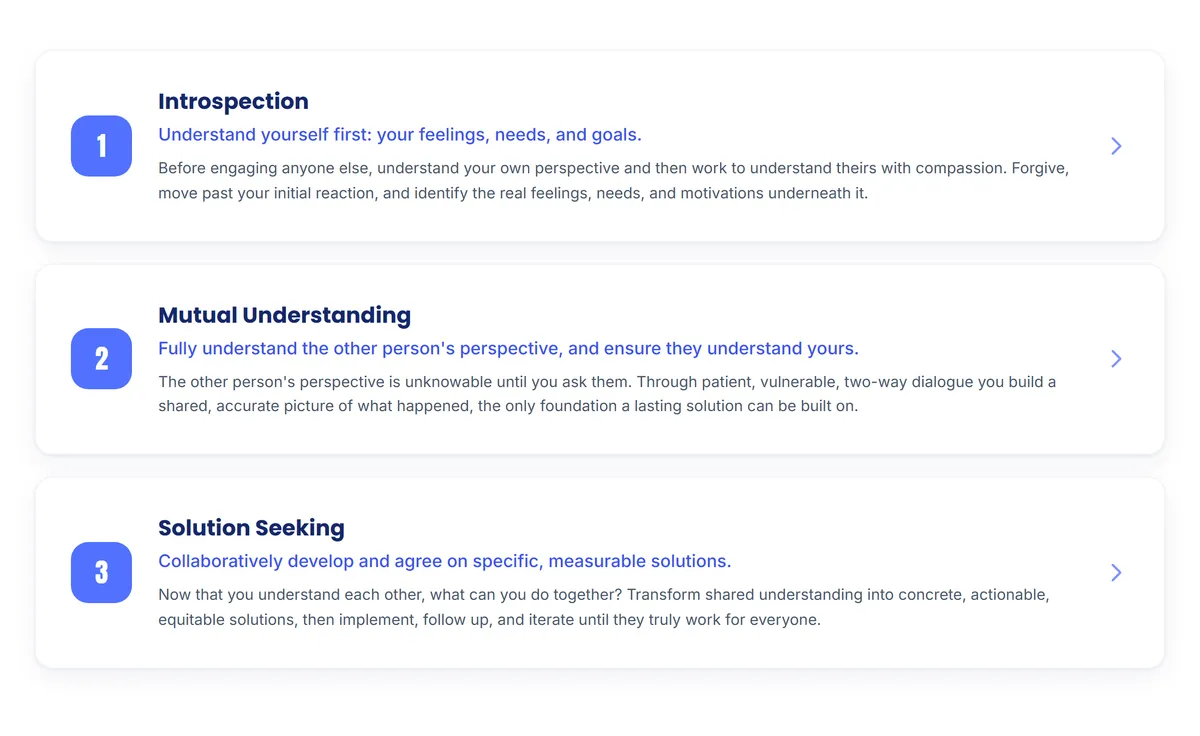
A protocol rather than a rulebook. Understand yourself first, then understand the other person, then go looking for a solution together. It runs our one-on-ones, the way feedback gets given, and the formal sessions we hold when something needs resolving. David and Shannon did not design it in the abstract: it started as the way the two of them had learned to talk to each other, and the rest was working out how to teach it.
Free, and that includes the complete guide, the worksheets and seven annotated example conversations. A paid tier covers unlimited practice with the AI guide.
Everything a new person was supposed to know, spread across a binder, three chat threads and one manager who happened to remember.
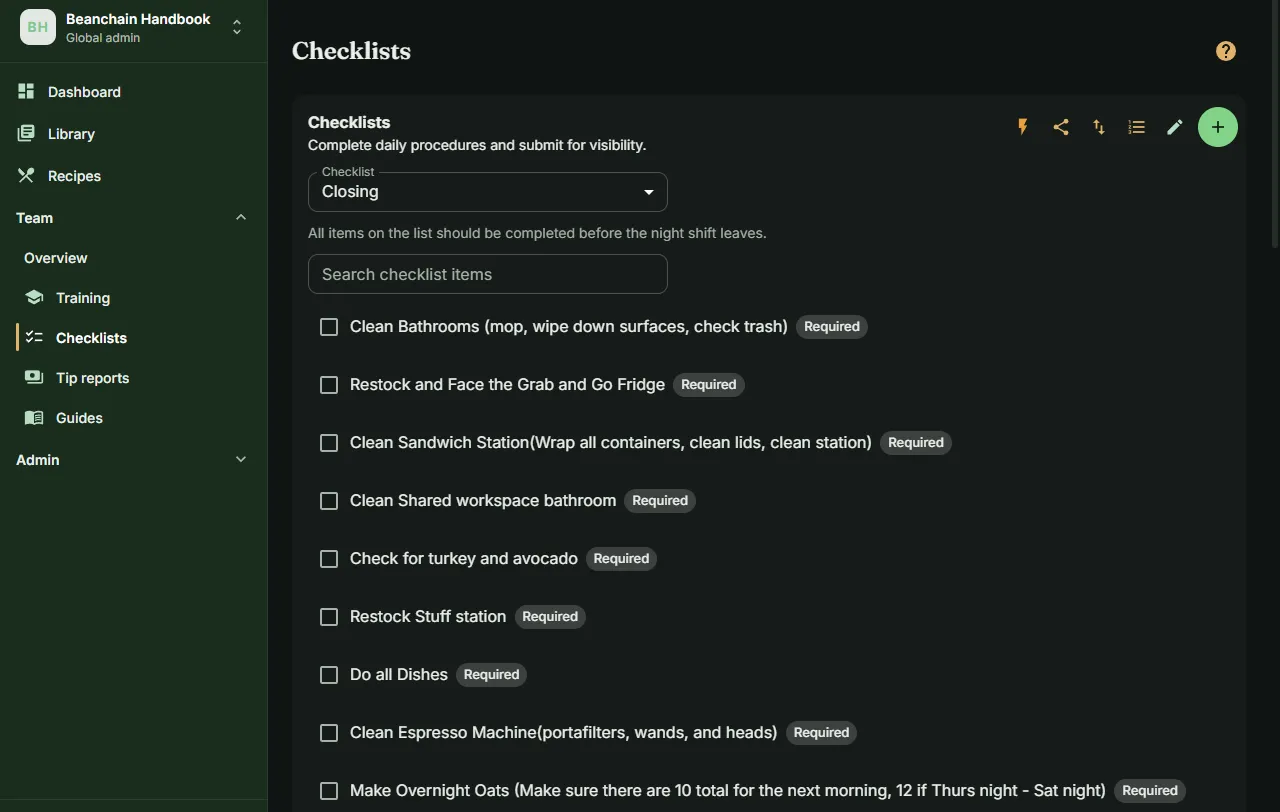
Training, standard operating procedures, recipes, checklists and inventory in one place, with an assistant that proposes changes and then waits for a human to approve them. It exists to make a small business easier to run, and it is also the quiet part of this plan. A business that has written down how it works is a business that can be handed to the people who run it. A business where only the owner knows how anything happens cannot be handed to anybody, whatever the owner intends. Handbook does not lecture anyone about democracy. It just makes shared decisions possible, which is the only kind of nudge that survives contact with a Tuesday.
$30 a month per handbook, plus $5 a month for each person on it. Fifteen day trial, no card.
Buy a meal for someone who needs one, from a local business.
The corkboard worked. It only worked if you were standing in front of it, and somebody had to keep a stack of receipts straight.
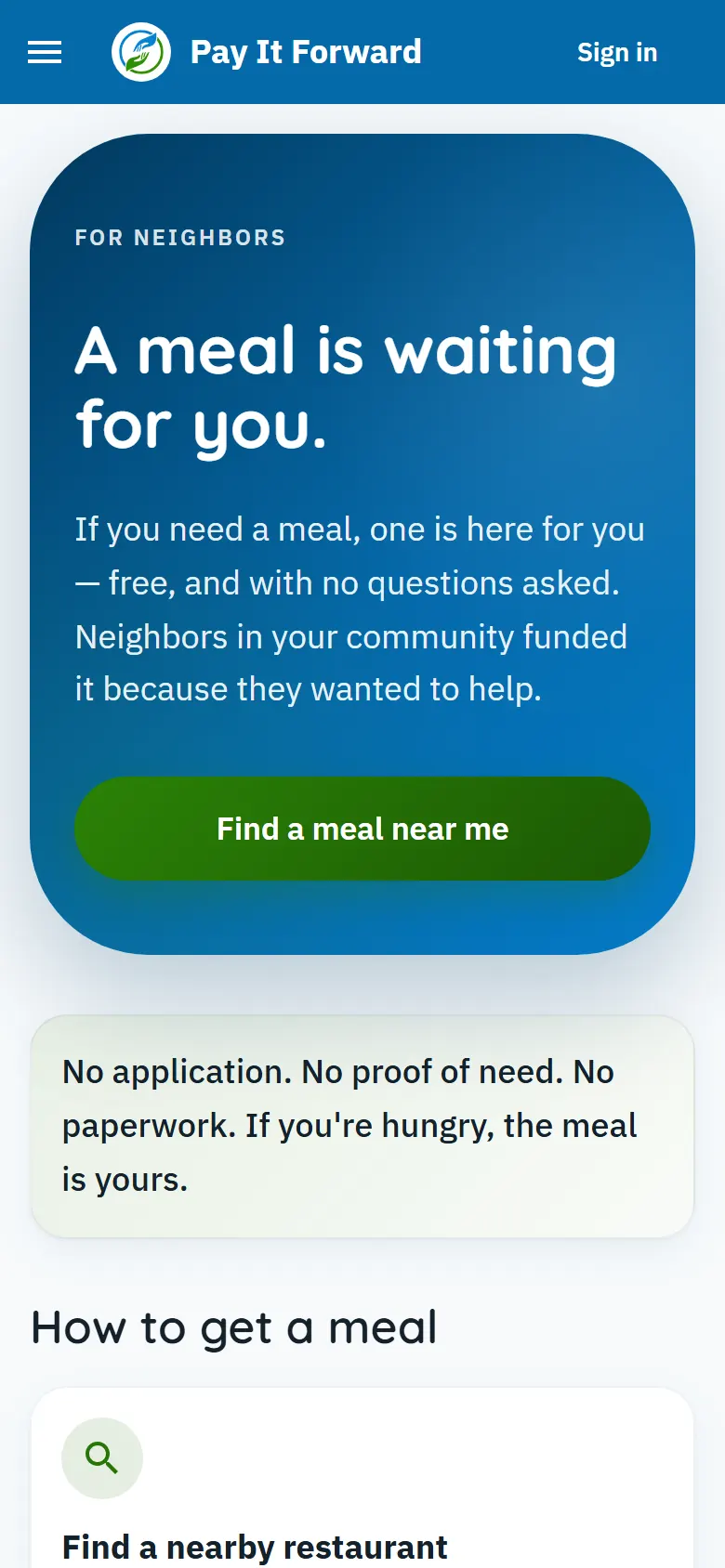
Somebody pays for a meal in advance. A local business provides it. Whoever needs it collects it, with nothing to prove and no conversation about whether they deserve it. The absence of that conversation is the whole design, because plenty of help comes with a line, a form, or a moment where you say out loud that you cannot afford lunch, and this does not. Moving it off the wall meant a donor in another city could buy a meal here, and a business three streets over could hand one out.
Donors pay for the meals, and the money goes to local businesses.
Runs as a project of the Foundation for Innovation in Society, a registered 501(c)(3) nonprofit (EIN 33-2320329). Donations are tax-deductible to the extent allowed by law.
Kids Flashcards is for children from age two and the grown-ups who sit with them. No
business runs on it, so the test above does not apply, but it was built here like the
rest, and it is free for any family to use.
flashcards.bchain.coffee
Kids Flashcards
Picture, color and voice flashcards for learners from age two.
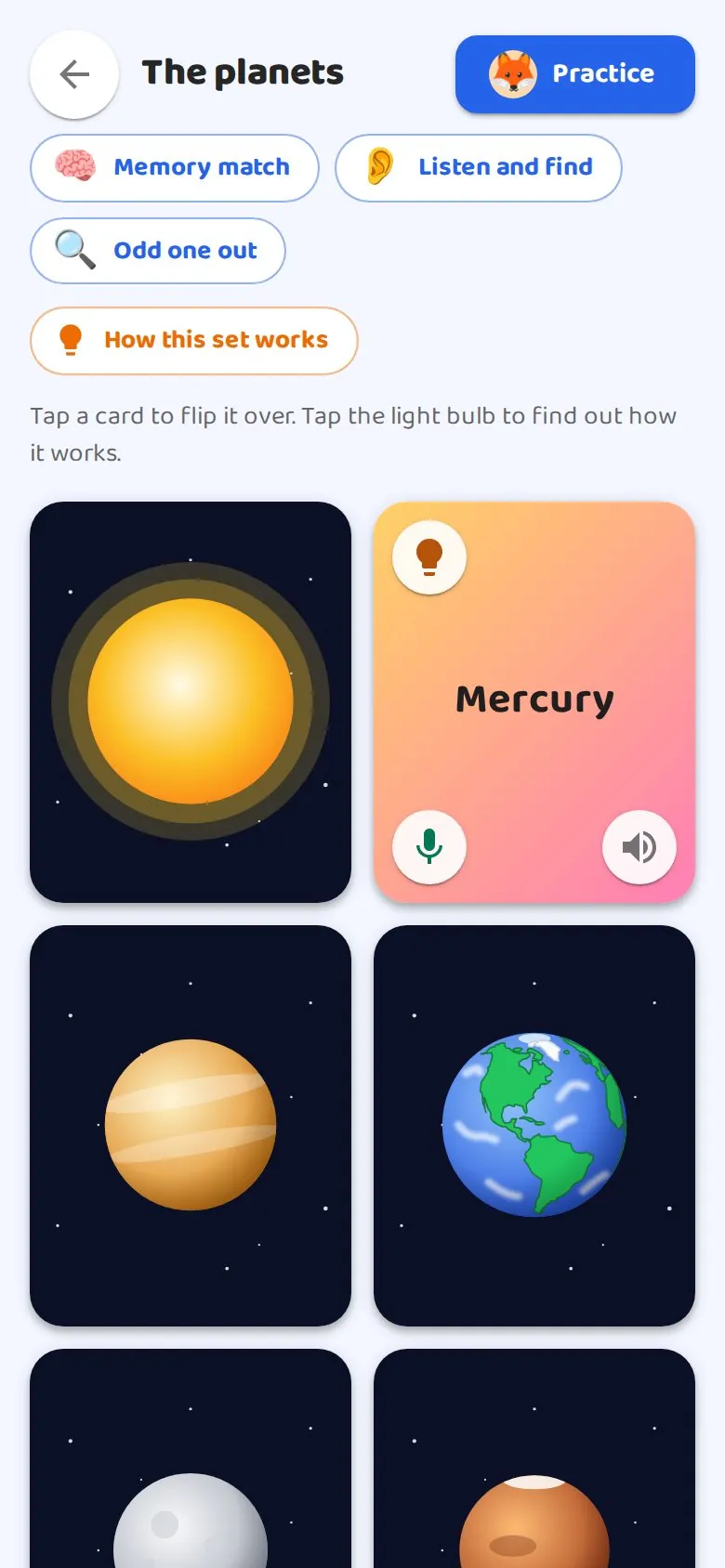
Sixty-three ready-made sets, from animal sounds and first letters to binary and logic gates, and any card can carry your own photo and your own voice.
Grown-ups make the cards. The front can be a photo taken in the app, a color, or a sum like 2 + 3, and the back is read aloud in your own recorded voice or by the device, in Spanish or French where a card is. Children flip them, play memory match and listen and find, and practice a few new cards at a time, each child with their own progress and a number of choices that adjusts as they improve. Finished rounds earn stickers, and the editing sits behind a multiplication question for the grown-ups. Everything a family adds is kept on the device rather than on a server.
Free, with no account. It installs like an app and works offline.
Guides to shelter, food, medical care and 24 hour crisis lines for Mesa, Tempe, Chandler
and Phoenix, given away here as printed trifolds and posted as web pages with numbers
that dial on one tap. Every entry is checked before it goes up, because a wrong number
costs somebody a walk across town, or a night.
The web version is arranged for somebody reading outdoors, on a phone, possibly on a
nearly dead battery, in 110 degree heat. No hero image and no photographs. Crisis lines
first. If you run a business in another city and want the same thing for your area, ask
us and we will make it.
Every work team in this shop is a cooperative that has not happened yet. A group forms
around real work and gets paid for it, learns to govern itself while the stakes are
small, and then leaves as its own cooperative entity: independent, self-governing, and
free to serve Beanchain, the wider network, and anybody else who needs what it does.
1 A team forms around real work
2 Gets paid for that work
3 Learns to govern itself
4 Leaves as its own cooperative
That is how a network gets grown rather than announced. A coalition of small businesses
only out-competes a corporation if the shared services are real, and services do not
appear because a diagram asks for them. They get built one team at a time, somewhere
small enough that getting it wrong is survivable, and then they go and stand on their
own.
Ending poverty in America takes thousands of cooperatives, not a handful. These are the
first two, and none of them is a company yet.
Beanchain Marketing Cooperative
The internal marketing work team, becoming a cooperative in its own right and taking on work from outside. Furthest along, because the team already exists and is already paid.
Solution Seeking Company
A cooperative to develop and maintain the tools for leadership, communication and system design, serving Beanchain and organizations with no connection to it.
With other shops
A cooperative of Arizona coffee shops
In 2026 Beanchain and three other shops started a cooperative, to work out together how
to cut their waste and their costs. Each shop stays its own business, and the shops decide
shared questions by consent: a proposal goes ahead when nobody has a reasoned objection to
trying it for a set time.
commongroundscoop.org
Common Grounds Cooperative
Independent Arizona coffee shops, working in common.
commongroundscoop.org
Waste is a tricky battle for us as business owners. We don’t want to create it, but our hands are tied by tight margins, corporate suppliers, and the waste/recycling/reuse infrastructure provided to us.
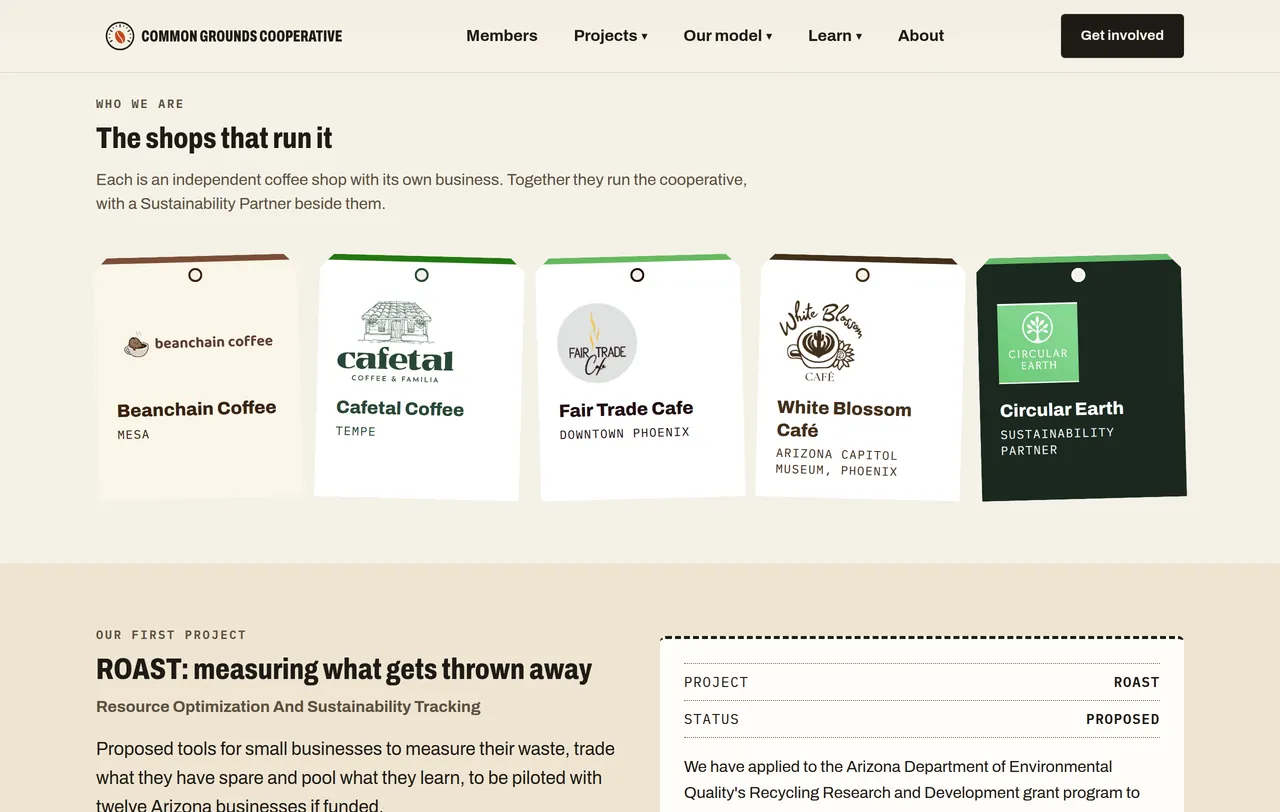
That is how the four founding Members put it, in their letter backing the cooperative’s first grant application. They are Beanchain, Cafetal Coffee in Tempe, Fair Trade Cafe in downtown Phoenix and White Blossom Café at the Arizona Capitol Museum. Circular Earth, a sustainability consultancy, works beside them as Sustainability Partner. The first project, ROAST, would give small businesses tools to measure their waste, trade what they have spare and pool what they learn. Those tools would be built on Handbook. It is proposed, not funded: the cooperative has applied for a grant from the Arizona Department of Environmental Quality, and the pilot starts only if it is funded. The cooperative itself is not a legal entity yet. The Members are still choosing its form.
Nothing is charged yet, because the Members have not set dues. An independent coffee shop in Arizona can ask to join on the cooperative’s site, and asking commits it to nothing.
All of it is free to take and none of it is gated or conditional on agreeing with
us. Run Pay It Forward at your own place through PIF Board, put the communication protocol into a business that will never be a cooperative,
print the unhoused guide with your own logo on it. We are not precious about credit. A
tool sitting on our shelf is a tool nobody has tested, and these only get good by being
used.
And we need the help. Tell us what broke, what confused you, what you had to work
around and what is missing entirely. An hour from somebody actually running one of
these is worth more than a month of us thinking about it in a coffee shop. If you want
to build a piece of it with us, better still. Say so and we will find you something
real to do.