A shop this size has no HR department to escalate to. That sounds like a gap until you look at what escalating would actually mean: a written warning, a file, a process that opens by deciding which of two people was at fault.
Most of what goes wrong between two people at work has no fault in it worth finding. Both of them meant well, both are tired, and each has a version of the week that makes sense from where they were standing. The usual toolkit has two settings for that, and they are saying nothing and starting a file. We wanted the thing in between and there was nothing to buy, so we wrote one.
Introspection, mutual understanding, then a solution
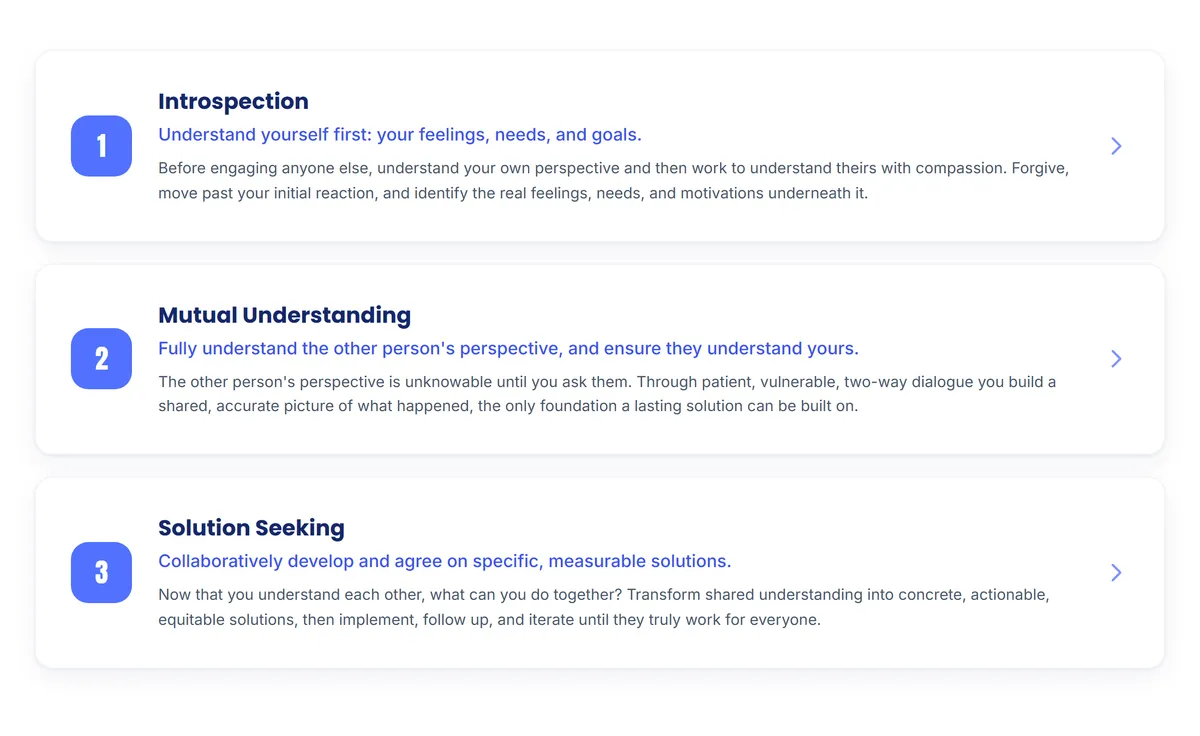
The order does the work.
Introspection is first because you cannot negotiate from a position you have not examined. Before you go near the other person you work out what you actually feel and what you actually need, which is rarely the thing you would have said in the moment. The system is blunt about the reason. Fear, anger, shame and frustration are indicators of a problem rather than the problem itself, and while you are gripping one of them you cannot see past it to whatever it was pointing at.
Mutual understanding is second, and it rests on one line that does more than its length suggests: the other person’s perspective is unknowable until you ask them. Not hard to guess. Unknowable. Everything you think you know about why somebody did something is a story you assembled, and the point of the second step is to replace it with an account both people recognise.
Only then does anybody go looking for a solution. A solution is not finished until it is actionable, testable, effective and time-bound, and until it works for everyone in the room. If it only comes out well for one side, the honest reading is that the first two steps were rushed.
What holds the protocol up
Underneath the three steps sit twelve principles, and they are the part that makes the protocol work rather than decoration around it. Understanding. Good faith, which is approaching somebody with the genuine assumption that they are also trying to act with integrity. Forgiveness. Humility, filed with a note about noticing when pride is doing the talking. Compassion and empathy. Bravery, vulnerability, patience, fairness, integrity, flexibility, critical thinking.
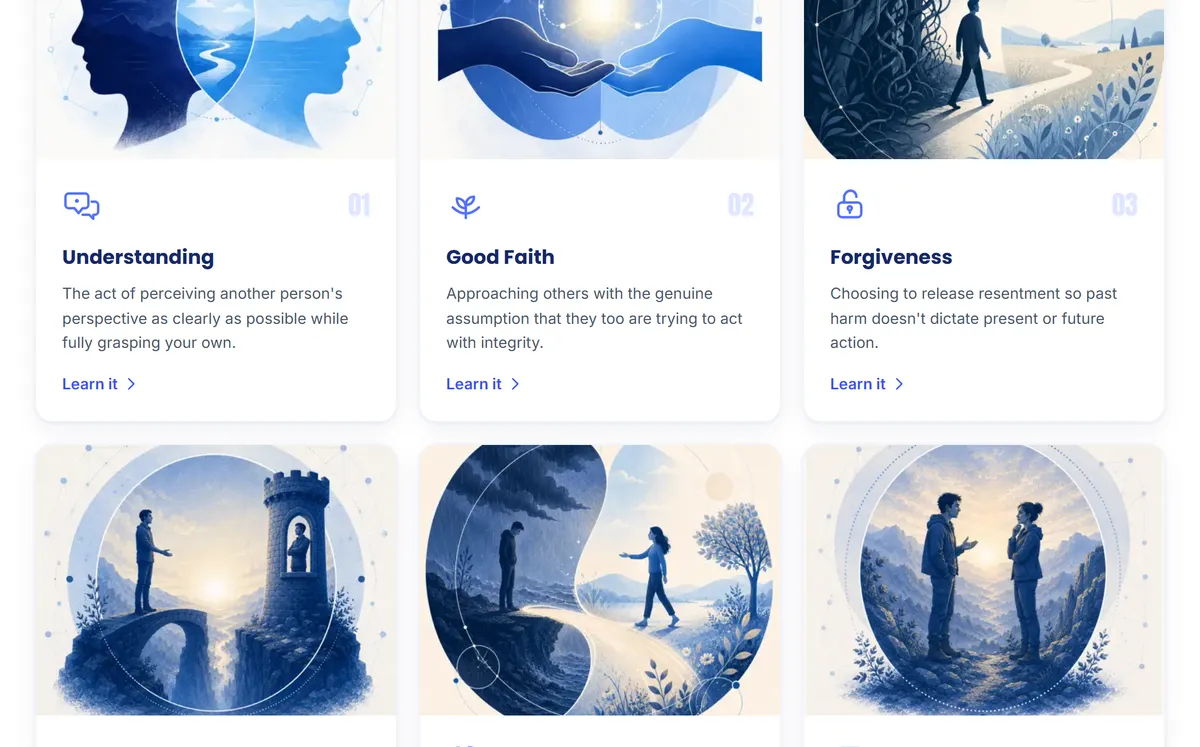
Four of them are singled out as the pillars of understanding: patience, vulnerability, bravery and compassion. Those four are what the second step actually costs you. It takes time you would rather not spend, it means saying something you would rather keep, it takes nerve to start the conversation at all, and it asks you to care about somebody you are currently annoyed with. Every principle has a page with what it is, how it gets used, what good practice looks like, and what it is not. That last part is more useful than it sounds. Bravery’s page is careful to say that acting without thought is recklessness rather than courage.
Where it actually gets used here
Four tools sit on top of the protocol and only one of them is for trouble.
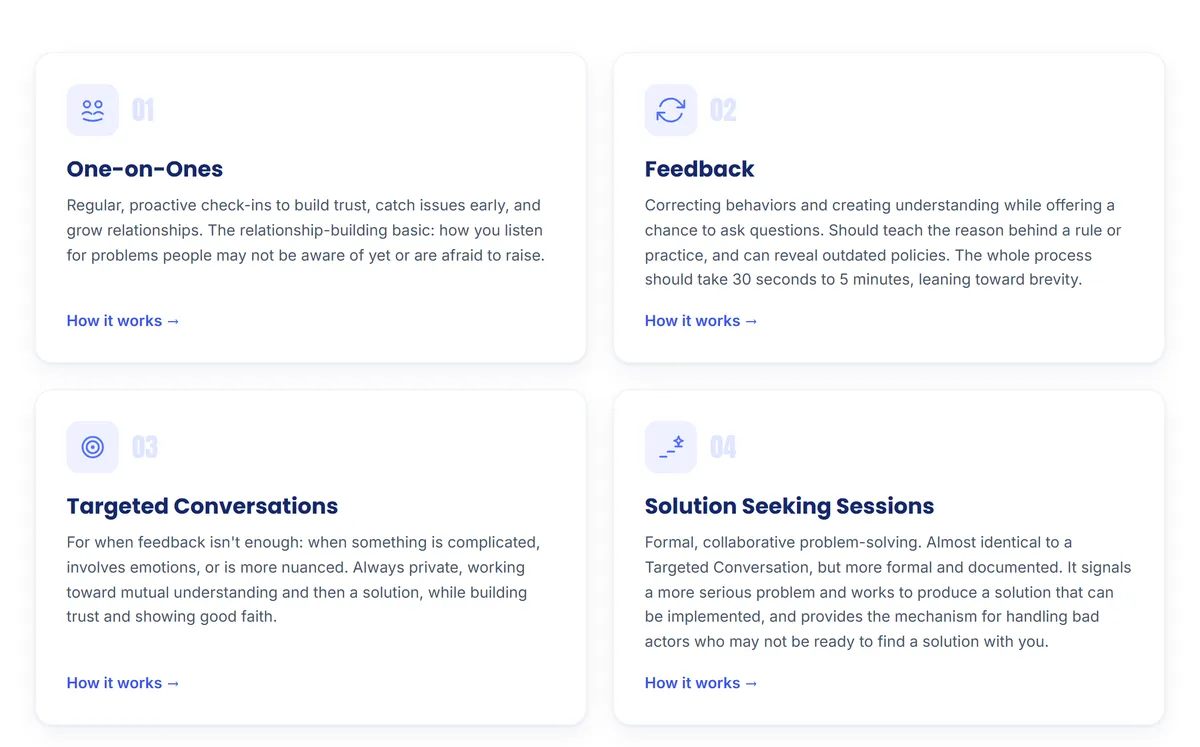
One to ones run on a predictable schedule and exist to listen for the problems people have not raised yet, or are afraid to. Feedback is the short one, thirty seconds to five minutes, and its job is to teach the reason behind a rule rather than restate the rule. It is also allowed to run backwards: somebody explaining why they did it their way is one of the more reliable ways to find out a policy has gone stale. Targeted conversations are private and prepared, for when feedback was not enough. Solution seeking sessions are the formal, documented version, and they are also the mechanism for the case the rest of this does not cover, which is somebody who is not acting in good faith.
That distribution is the whole reason it holds. By the time something has gone properly wrong, everyone involved has already used this dozens of times on things that did not matter. Nobody is learning the format on the worst day of their year.
All of it is free
The system is free and stays free: every page, the complete guide as a PDF, the worksheets, and seven annotated example conversations. That is not generosity. A protocol only gets good by being used and argued with by people who did not write it, and anything you have to pay for before you can try it is a thing almost nobody tries.
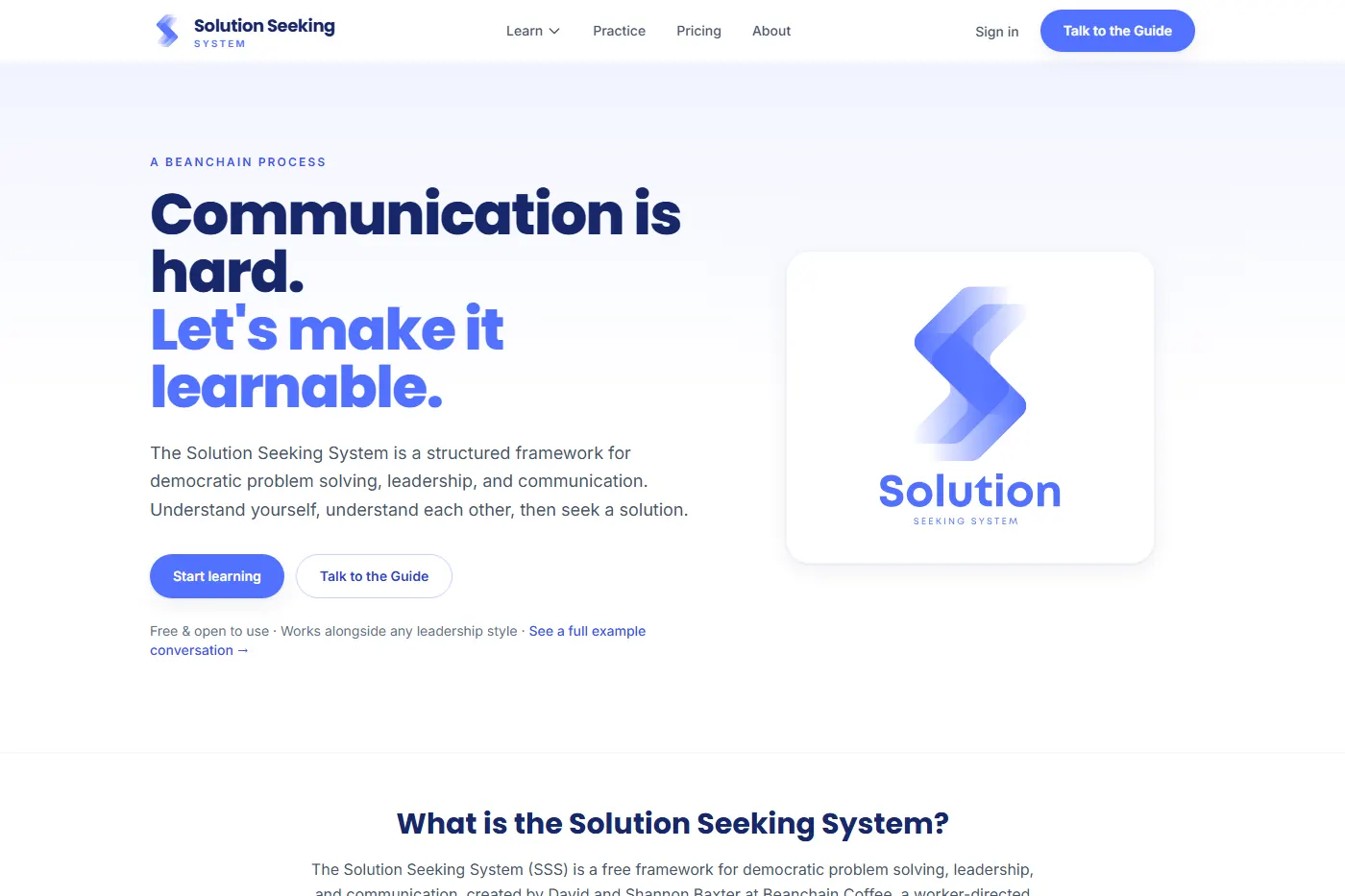
It lives at solutionseeking.com, which also has an assistant you can talk a real situation through with if you want one. That part is a convenience rather than the point. The protocol works on paper, and it worked on paper first. If you want the full framework rather than this account of living with it, the long version is here, and we have written separately about feedback and one to ones.
Why a coffee shop wrote a communication protocol
The shape of it came from home before it came from work. Shannon and I had already worked out how to disagree without either of us needing to win, and most of the effort since has gone into turning that into something you can hand to somebody who was not there while we learned it.
Stage one of the plan is to run a real coffee shop, hand it to the people doing the work, and write down every part of how, so nobody has to work it out from nothing twice. A group that cannot disagree without a manager standing in the middle cannot be handed anything. Whoever ends up holding this place will disagree with each other, and that was never the question. The question was whether they would have something better available than a warning letter, and whether it would already be familiar by the time they needed it.
We are not a cooperative yet. That word arrives with the first members voted in. This is one of the pieces that has to exist first, and it is one of three that started as a problem here we could not buy our way out of.