A conversion that takes control away from an owner overnight is one most owners never start. And nothing in the usual route accounts for what building the business cost them. So at Beanchain we are testing a different design, meant to be easy enough that an ordinary owner would actually take it. Nobody has been voted in and nothing has been sold yet, so read this as a design rather than a result.
It starts as an ordinary business
The founders start it and own it, and for all practical purposes it is a standard business. Then people come to work there, and the path opens.
The path for the people who work there
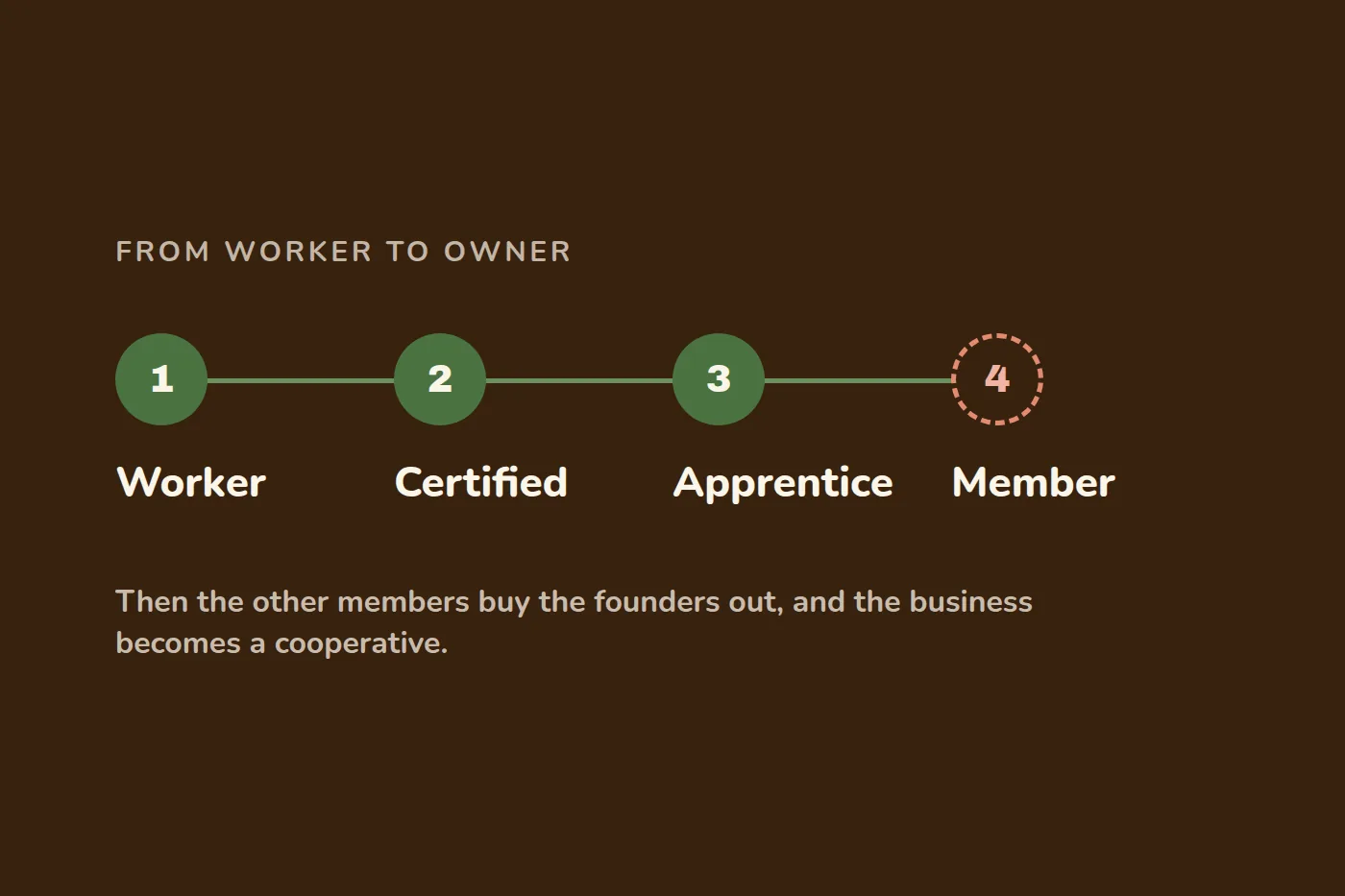
Worker. You are paid for your shifts and nothing else is asked of you. Plenty of people will stay here, and that is a fine choice.
Certified. If you want more say, you learn the Solution Seeking System and how Worker Direction works, and show a founder or member that you understand both. That is Participation Certification. It opens the teams, the forums and the paid work, where people decide things about their own work.
Apprentice. If you want to become an owner, you ask to start an apprenticeship. A founder or member mentors you. It lasts at least a year, and what you put in is sweat equity rather than money, because a model where joining means buying in only admits people who already have money.
Member. The existing members, founders included, vote you in, and our written design asks for that vote to be unanimous. A member holds an equal vote, shares in the profit, and carries the risk when a year goes badly.
What the founders keep, and for how long
The founders are members too, of a special kind: the people who started the business, or the owners converting one they already had. Anything said about members in general includes them. The founders vote and share in the profit like any member, and they also keep a veto until the other members buy them out. The veto exists because an owner who could lose the business overnight would never begin, and a conversion abandoned halfway helps nobody who works there. At Beanchain it has never been used.
And the founders are owed something for starting the business at all.
Founder repayment
Starting a business takes money, risk and years of work that nobody pays for. Founder repayment pays that back: the money the founders put in, the risk they took, and the wages they went without. It comes out of the profits before anybody’s profit share is worked out. Each company decides what share of its profits goes to it each year. We plan to put around 10% a year towards ours until it is paid off.
This part is personal. Shannon and I have worked more than 250 hours a month for four years, with no weekends, through birthdays and anniversaries. We have never taken a full paycheck, only enough for rent and food. Getting this far has taken everything we have, and more than we thought we had.
An owner thinking about a conversion is weighing years like those. If handing the business to the workers meant writing them off, very few owners would do it. Repayment is how the design respects what founding takes out of a life, and it is a large part of what could persuade other owners to move towards worker ownership.
The buyout
The last step is the other members buying the founders out. That completes the transition: the veto ends, and the business becomes a traditional cooperative, owned and run by the people who work in it.
The legal form
We do not mind much which legal form it ends up in, as long as it upholds cooperative values and gives the people who work here real ownership. Co-op, ESOP or something else goes through the options.
What we have not published
We have not published the repayment total, or how the business will be valued for the buyout. Everything that depends on somebody being voted in is still untested. When somebody is voted in, it will be written down here, including whatever the design got wrong. In the meantime, where the handover stands is reported with dates.