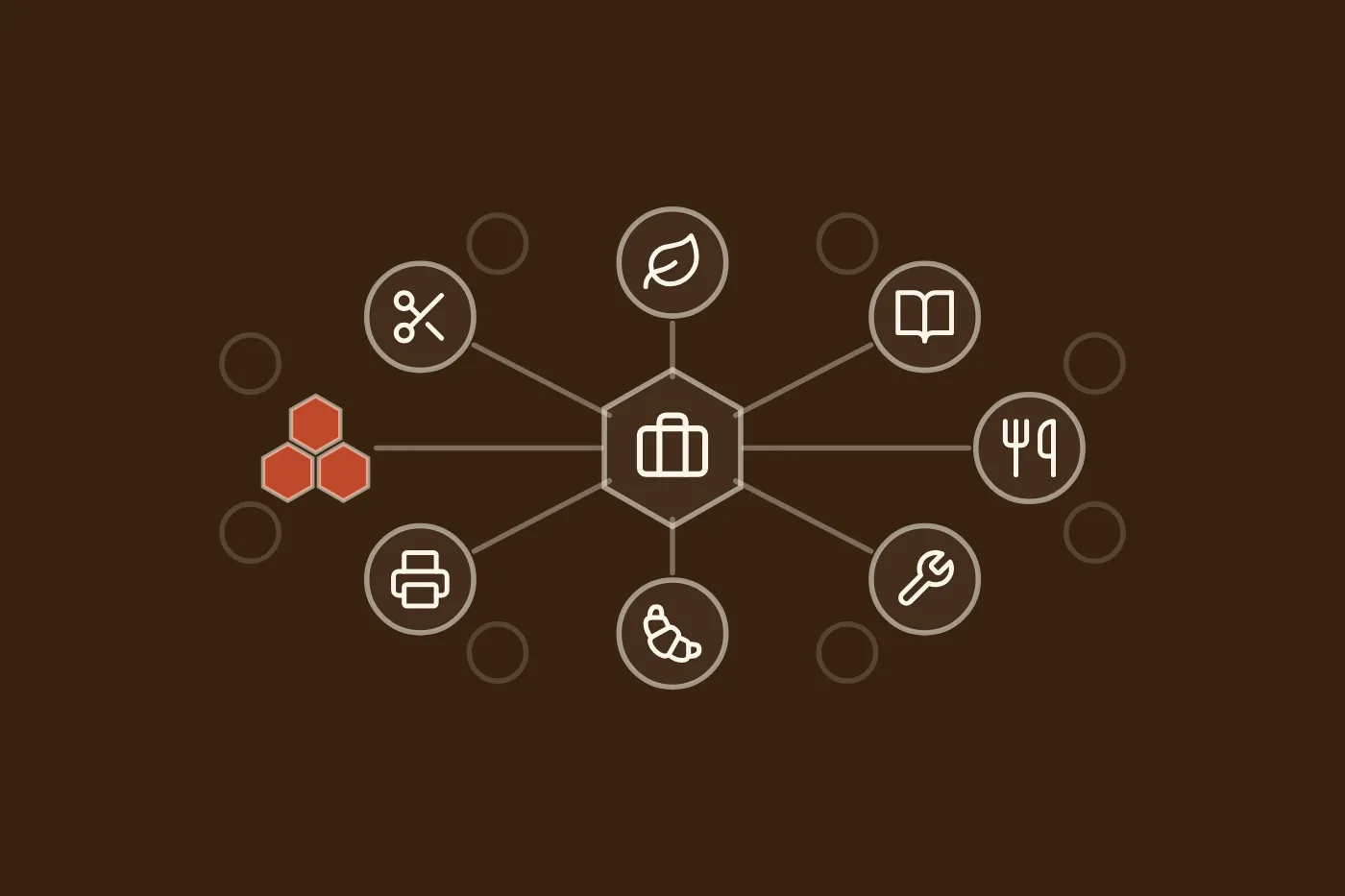
The first two stages of the plan are about Beanchain. Run one shop well and hand it to the people who work in it, then grow in Cells around a nonprofit that does the shared work. The third stage is about everybody else. We call it the Cooperate Network, and its job is to open those shared services to businesses that are not Beanchain and never will be.
A corporation gets cheap legal help and proper IT because it is enormous, and a small business either pays full price or goes without. Shared between enough members, services like those cost each business less, and that is what lets a small business grow without selling itself to somebody bigger to get there. The money and the power stay in each business and the town around it.
Nobody has to be a co-op on day one
Businesses come to this from different places. The most common reason a company becomes employee-owned, according to the National Center for Employee Ownership (NCEO), is an owner who wants out and does not want to leave the business to private equity or some other outsider. Other owners simply want the people who run the place every day to own part of it. And sometimes a group of workers wants to start something of their own. Asking every one of them to become a worker cooperative first would turn most of them away at the door.
So the network will be open to several kinds of ownership, as long as the business is owned by the people who work in it or the community it serves, or is honestly working towards that.
The forms, and who holds the vote
They differ in plenty of ways. The one we care about most is who gets a say.
Worker cooperatives. Each member has one vote, and the members elect the board. Joining usually means paying a membership fee and being voted in by the existing members. Most co-ops hold their equity collectively rather than dividing it among the members, and pay members dividends based on the hours they worked. The NCEO describes them as typically smaller companies with a philosophical commitment to democratic governance, which is a fair description of what we are trying to become.
Employee stock ownership plans (ESOPs). These are the most common form of employee ownership in the United States, with 6,411 companies covering 15.1 million employees on the NCEO’s most recent count. An ESOP is a retirement plan that holds company stock in a trust for the employees. Employees do not buy the shares. The company pays for them out of future profits, and employees are paid cash for theirs after they retire or leave. Most ESOPs are set up to buy out the owners of a privately held company.
The catch is the vote. The trust is the legal shareholder, and a trustee appointed by the board votes the shares. In a privately held company, employees direct that vote only on a handful of major decisions, such as selling all or nearly all of the company’s assets. Whether they vote for the board, or on anything else, is up to the company, and so is their part in running it day to day. An ESOP can be a quiet retirement account or something close to a workplace democracy, and which one it turns out to be depends on the company.
Employee ownership trusts. A trust owns the company, which gives legal protection to whatever the seller wants preserved, such as its legacy or its benefit to the community. Most are designed to be permanent, so that the company is not sold on to another buyer, which an ESOP may not be able to promise. Whether the employees get any say, and how much, is generally up to the seller.
A seller can defer capital gains tax on a qualifying sale to a worker cooperative in the same way as on a sale to an ESOP, under Section 1042 of the tax code. Which form fits is a question about the business and the people in it, and we would rather help somebody choose well than push everyone into one shape.
What ownership does for the people who work there
The NCEO keeps a summary of the research, most of it on ESOPs. A few of the studies it lists:
- S corporation ESOPs surveyed in 2023 reported voluntary quit rates around a third of the national average. Their employees had a median ESOP account of $80,500, against $30,000 for their counterparts at companies without one.
- In a 2017 study of workers aged 28 to 34, being in an ESOP went with 92% higher median household net wealth, 33% higher median income from wages and 53% longer median job tenure than peers without employee ownership.
- Twenty years of the General Social Survey, 2002 to 2022, show that people who owned shares in the company they worked for were laid off at a rate of 1.9%, against 5.1% for those who did not.
These are comparisons rather than experiments, so they show what goes with employee ownership more than what it causes.
The most useful finding for us is older. A 1986 study divided privately held ESOP companies into three groups by how participatively they were managed. Only the most participative grew faster than expected, by 8% to 11% a year. The middle group grew about as expected, and the least participative declined. The General Accounting Office reached a similar conclusion in the 1980s: without worker participation, employee ownership did not make workers more productive or companies more profitable.
Owning shares was not enough on its own. The companies that did better were the ones where the employees who owned them also had a real say in how the place was run, and that is the argument behind Worker Direction.
What the Cooperate Network would ask
We do not have terms yet, and we will not invent them here. What we have is the shape of it.
Joining would mean signing a strong participation agreement, and part of it would be an ethical agreement with two commitments in it. A member keeps a structure owned by its workers or its community, or commits to working towards one. It also works towards paying a living wage within a reasonable time. We would support members in both, and audit them on both.
Members would also pay dues, and the dues would do two jobs. They would pay for services, both the ones the network provides and the ones members provide for each other. And they would go into a fund that helps start new cooperatives and helps existing businesses convert, bringing each of them into the network as it goes. That is how the network can pay its own way and still grow quickly.
Which services exist will depend on what the members need and what they are good at. We expect to build a lot of them ourselves, the way the tools on our projects page were built: because we needed them and could not buy them.
The aim is a network that thrives financially and enriches every one of its members, and is a vehicle for the dignity and wellbeing of the people working inside them.
Where the ideas come from
We were influenced most by Richard Wolff’s Democracy at Work: A Cure for Capitalism (Haymarket Books, 2012), which makes the case for democracy inside the workplace. Mondragon, the federation of cooperatives in the Basque Country that the Cells post describes, is the closest working example we know of what stages two and three are reaching for.
What exists today
None of it. Beanchain is still one shop working through stage one, with nobody voted in as a member yet, so we are not even a cooperative ourselves. Stage two has not started, and stage three comes after it. There is no agreement to sign, no dues, no fund and no services to offer yet.
If you own a business and any of this interests you, whether you are thinking about retirement or about who should own the place one day, email us. We would rather hear from you before any of it is settled than after.