
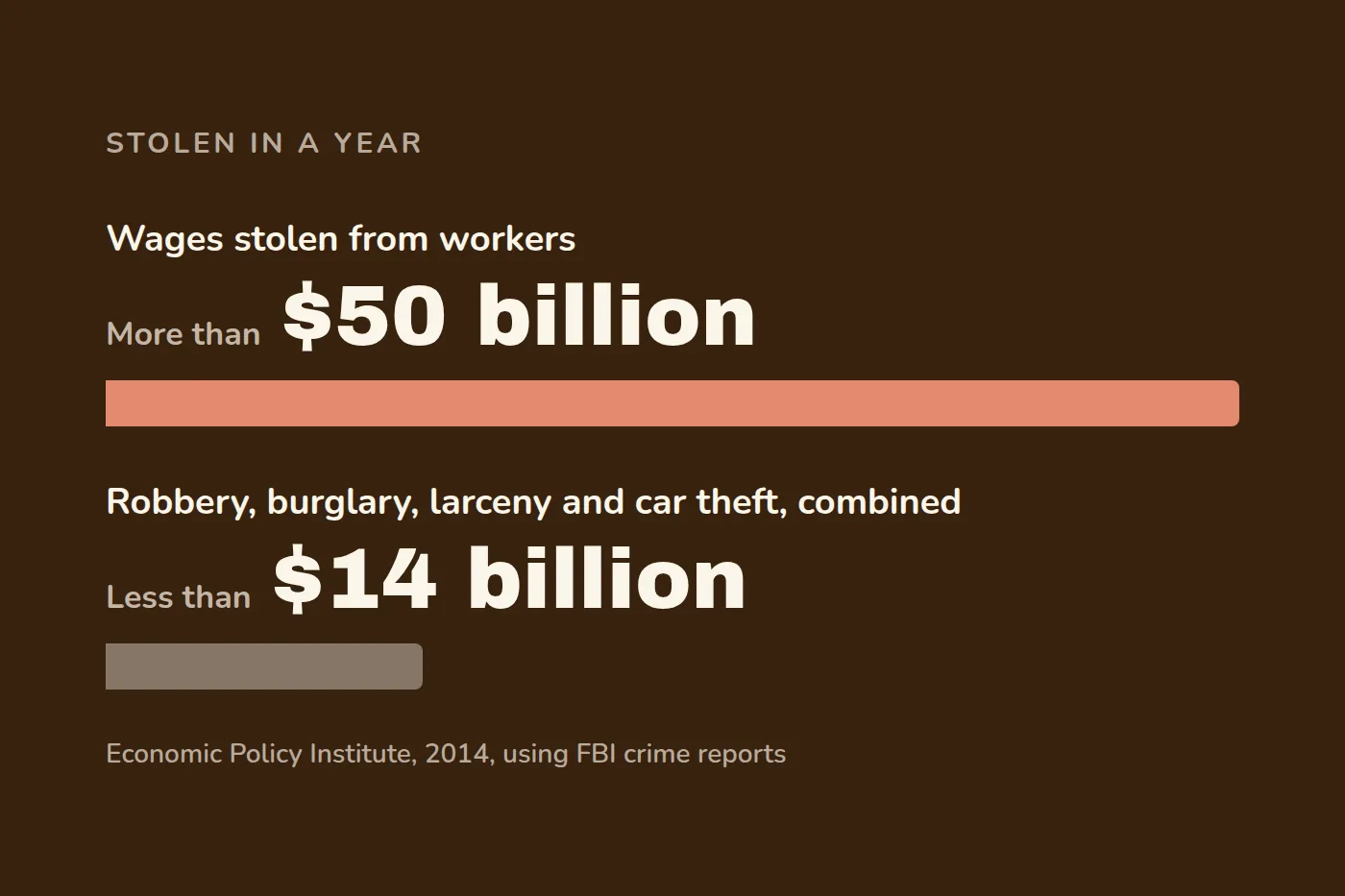
We built a coffee shop to argue with a problem, and the problem has a number attached. In 2014 the Economic Policy Institute estimated that wage theft costs American workers more than $50 billion a year. In 2012, every robbery, burglary, larceny and motor vehicle theft reported to police anywhere in the country cost its victims less than $14 billion.
Read that the slow way. Employers keeping money their staff have already earned takes more out of people’s pockets than all the muggings, break-ins, shoplifting and stolen cars put together, more than three times over. It is the largest category of theft in the country, and the one with the least fuss made about it.
What counts as wage theft
Nothing exotic. Most of it is a few minutes or a few dollars at a time:
- Hours over forty paid at the flat rate, or not paid at all.
- Calling an employee an independent contractor, so the protections never apply.
- Paying under the legal minimum.
- Setting up before the shift and cleaning down after it, unpaid.
- Taking money out of a paycheck without the right to.
- Hours worked and wages that never arrive.
The small amounts are the point. The Economic Policy Institute gives its own example. At the 2014 federal minimum, a forty-hour week paid $290, and shaving half an hour a day off somebody’s pay cost them more than $1,400 a year once overtime was counted. That could be close to a tenth of everything a minimum-wage worker earned.
Where the $50 billion comes from
It is an estimate, and it is worth knowing how it was made. A study of low-wage workers in New York, Chicago and Los Angeles found that two thirds of them had lost pay to at least one violation in a given week. The average worker lost $2,634 over a year, out of total earnings of $17,616, and across the three cities it came to nearly $3 billion. The $50 billion is what you get if those three cities are typical of the 30 million people in low-wage work across the country.
The crime figure is a different kind of number. It comes from the FBI’s Uniform Crime Reports, which count crimes reported to police. Robbery alone, the crime most people picture when they hear the word theft, took $340,850,358 in 2012, across 292,074 robberies.
Neither figure is exact, and they are not from the same year. What makes the comparison hold is that both are bounds: wage theft is more than $50 billion, and the four crimes together came to less than $14 billion. The chart on Work life unbalance draws each bar at its bound, so if anything it understates the gap.
The part that does get paid back
Some of it is recovered. The Economic Policy Institute added up what was won back for workers in 2012 through the federal Department of Labor, state labor departments, state attorneys general and class actions brought by private lawyers. It came to at least $933 million, almost three times everything taken in every robbery in the country that year. Even that total is short, because it could not find the figures for several states, Arizona among them.
And it is still only the part somebody fought for. Most people never complain and never sue.
Why it keeps happening
Because the arithmetic favours the employer at every step. The amount taken from any one person is small enough that fighting back costs more than the wages did, and fighting back can cost you the job as well. In one case the brief describes, a Manhattan restaurant cut the hours of the two busboys who had spoken up, and then fired them. The penalties are small when they come at all. In 2014 the most the federal government could fine an employer for failing to pay the minimum wage or overtime was $1,100 a violation.
None of that requires a villain. It is what happens by default when the people who decide how a business runs are never the people it runs on.
What this has to do with a coffee shop
Everything we do here is a bet against that default. Worker Direction means the people doing the work have a say in how it runs, and a business run that way is a hard place to shave half an hour off anybody’s day. The plan is to hand this shop to the people who work in it, and to make that easy enough for other owners to copy.
We are not a cooperative yet, and nobody has to take our word for any of this. The figures are on Work life unbalance with their sources, and the Economic Policy Institute’s brief has the rest, including the cases.